
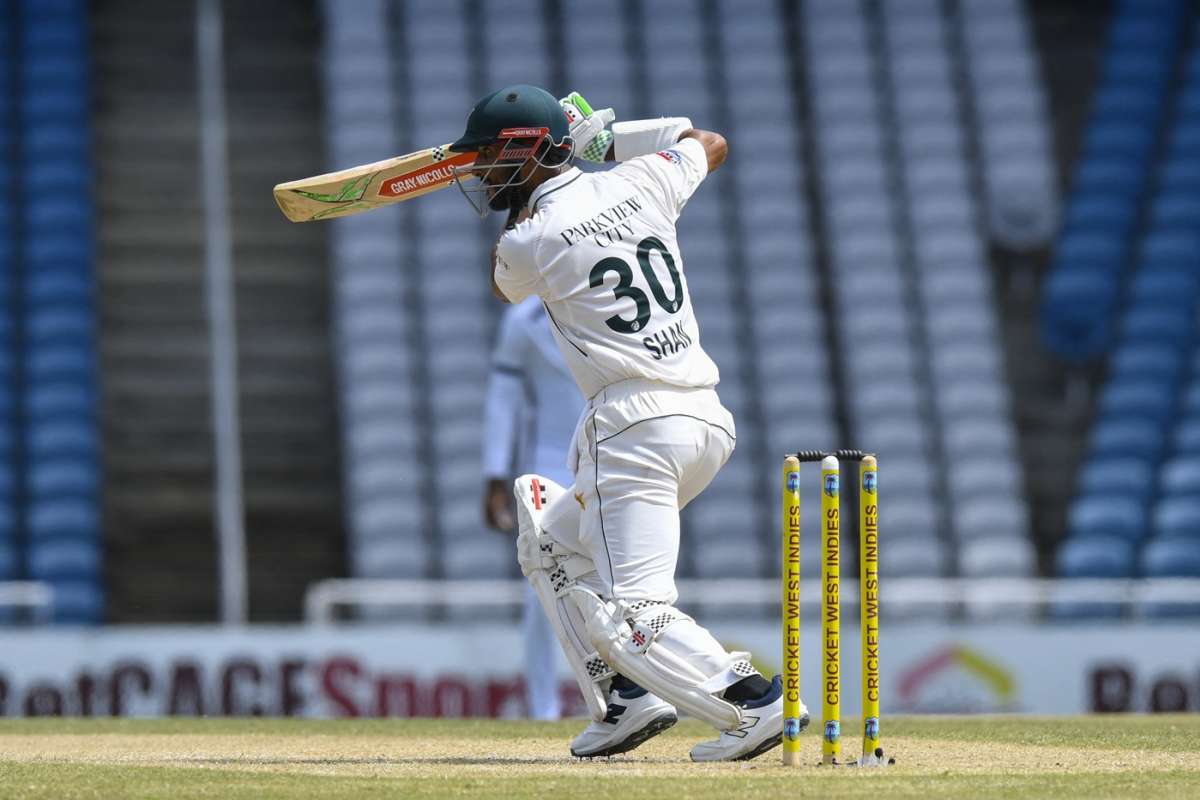
The first Test match between Pakistan and West Indies at Tarouba ended in disappointment for cricket fans across the nation, and particularly for the cricket community in Karachi. What started as a highly competitive encounter turned into a 90 run defeat on Day 4. Karachi’s very own Shan Masood played a monumental innings that set the foundation for a potential away win, but a combination of an unfortunate injury and a sudden batting collapse denied Pakistan a victory.
Heading into this series, Shan was under immense pressure. Having recently lost his captaincy, many critics were loudly doubting his place in the playing eleven altogether. Before losing the leadership role, Shan had even faced the axe from key positions due to losing matches from winning scenarios. While the team missed out on several victories under his watch by failing to close out key moments, it seems a change in leadership hasn’t changed the script. The same familiar pattern continues to cost the national team, as Pakistan once again let a winning game completely slip through their fingers.
Despite all the talk outside, Shan had the full backing of head coach Sarfaraz Ahmed, who made it clear that the team valued him as a senior batsman. Sarfaraz put his own reputation on the line by trusting him, taking the heat off Shan’s shoulders at a time when a failure would have left the coach with a lot of answering to do. In the end, that mutual trust paid off, and the local Karachi connection worked wonders on the field.
Shan repaid that faith immediately, silencing his critics with a brilliant, gritty 109 in the first innings. Representing Karachi with immense pride, he showed the exact technique and determination Pakistan needed, putting the team in a commanding position. However, just when things were looking up, he suffered an unfortunate fractured index finger.
This injury proved to be a critical turning point, a fact explicitly highlighted by captain Babar Azam in the post match presentation. When asked whether Pakistan missed a fully fit Shan, Babar remarked, “Unfortunately he has a hairline fracture and him not being able to bat at three did have an impact. But, the basics stay the same, you have to survive the new ball and look to score when it gets a bit old.” With Shan unable to walk out at his usual number three spot in the second innings, the tactical balance of the batting order was heavily impacted. Given his sublime first innings form, a fully fit Shan Masood would have provided the necessary stability to anchor the chase and potentially alter the entire complexion of the match in Pakistan’s favor.
While Shan Masood, Imam ul Haq, and Babar Azam played vital roles during the match, the rest of the batting department struggled to find momentum. In the first innings, Imam ul Haq provided excellent support to Shan, building a crucial partnership of over 150 runs that put Pakistan in the driving seat. Beyond these key performances, however, there was a noticeable lack of application and adaptation to the conditions from the remaining batsmen.
The second innings chase of 211 runs exposed this vulnerability. In a telling statistic that perfectly illustrates the depth of the batting struggle, the entire team managed to score just 26 runs in the second innings if we exclude the contributions of Babar Azam, Mohammad Abbas, and extras. In fact, extras actually ended up as the third highest scorer for Pakistan in that innings, underscoring a complete lack of partnerships or resistance from the rest of the lineup.
Pakistan’s primary setback was the inability to capitalize on the massive platform that the top order had provided earlier in the match. The batting line up experienced a sudden slide, losing the last seven wickets in quick succession. An addition of even 100 runs from the middle and lower order during the match would have safely secured the target.
The stark contrast between the two teams lay in the contribution of their respective lower orders. While the West Indian tail fought hard to add crucial runs that dragged their target past 200, Pakistan’s lower order could not offer sustained resistance. Ultimately, the valiant efforts of Shan’s majestic first innings century, Imam’s steady support, and Babar Azam’s resilient fifty plus score in the second innings went unrewarded.
While the batting department will face scrutiny, the performance of the bowlers remains a massive positive. Mohammad Abbas was the key notable performer of the game, taking a total of eight wickets in the match. Operating with meticulous control rather than outright pace, Abbas relied on superb lines and lengths to dismantle the West Indian batting, returning a brilliant five wicket haul in the second innings. He was excellently supported by Mohammad Ali, who picked up five wickets, and Khurram Shahzad, who took four wickets using a similarly disciplined approach.
As a historic silver lining, both Shan Masood and Mohammad Abbas etched their names into cricket history during this game. The two Pakistanis made it onto the prestigious honours board of the Brian Lara Cricket Academy, which was hosting its first ever Test match. Shan earned his spot as the venue’s maiden Test centurion with his gritty 109, while Abbas secured his place with his magnificent five wicket haul in the second innings.
As the team moves to the Queen’s Park Oval for the second Test, the management will look to address the gaps in the batting order to match the steady discipline shown by the bowlers. Karachi celebrates Shan’s incredible individual achievement, Sarfaraz’s leadership by example, and the fighting spirit of the bowling attack, while hoping for a stronger collective team performance to break this repetitive cycle and level the series in the next game.
