
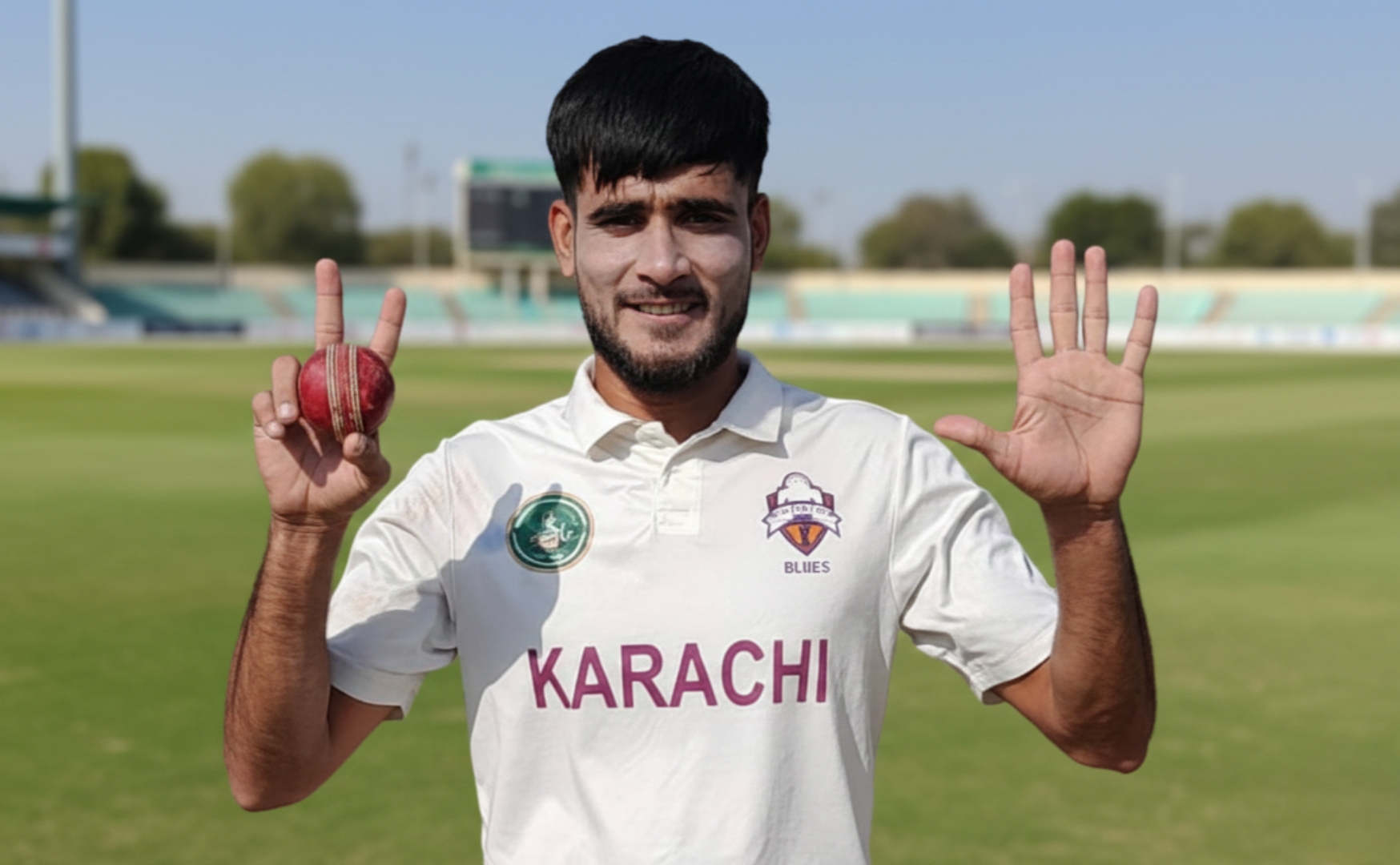
By the time the final session began to tilt Karachi’s way, the script felt familiar. A thin fast bowler pounding the pitch, crowd rising with every dot ball, batters shrinking into their crease. In Pakistan’s premier domestic season, the moments that mattered most kept circling back to one name: Saqib Khan.
In a year when Karachi’s new generation reclaimed the Quaid-e-Azam Trophy, Saqib emerged as the attack’s pulse. He finished the season as the tournament’s second-highest wicket-taker and the standout fast bowler across Karachi’s red-ball campaigns, earning him clear honours as the city’s Bowler of the Year.
Saqib’s numbers in the Quaid-e-Azam Trophy tell only part of the story. Across nine matches and 17 innings, he claimed 47 wickets at 20.59, striking three five-fors and producing a career-best 7 for 34 — the most wickets by a Karachi pacer in a single season in over a decade. Only Multan’s Ali Usman finished ahead of him on the overall charts.
But the real weight of Saqib’s impact lay in timing. Midway through the season, Karachi were staring at elimination, their margin for error reduced to zero. They needed five consecutive wins to stay alive. Saqib responded by turning pressure into fuel. Whether with the new ball under morning cloud or grinding spells late in the day, he delivered breakthroughs exactly when Karachi needed them most.
His ability to land the ball on a probing length, extract subtle seam movement and sustain intensity over long spells made him captain Saud Shakeel’s most trusted weapon. Karachi didn’t just win matches; they dominated sessions — and Saqib was often the reason why.
If the road to the final was built on consistency, the trophy itself was sealed by ruthlessness. Against Sialkot in the title clash, Saqib produced a match-defining performance, finishing with 9 wickets for 165. His five-for on the final day broke Sialkot’s resistance just as the contest threatened to stretch deep. The early dismissal of Mohammad Hurraira on day five cracked the chase open, and Karachi never loosened their grip.
Karachi cricket has long been defined by its batters such as: Hanif Mohammad’s endurance to Younis Khan’s authority and Asad Shafiq’s elegance. Saqib’s rise signals a shift in that narrative. This was a Karachi side powered as much by pace as by poise.
Importantly, his excellence was not limited to a single competition. Across all three major red-ball tournaments this season, Saqib was Karachi’s most reliable strike bowler.
In the President Trophy 2024–25, he featured in two matches, bowling four innings and taking five wickets, with best figures of 3 for 35 — modest returns, but a foundation for what followed.
The Hanif Mohammad Trophy 2025–26 marked his true surge. In just four matches, Saqib tore through line-ups to take 21 wickets in seven innings, claiming two five-wicket hauls and recording best figures of 6 for 35. It was a clear statement of intent ahead of the Quaid-e-Azam Trophy.
Then came the season-defining run in Pakistan’s premier first-class competition: 47 wickets, three five-fors, relentless spells and match-turning moments that defined Karachi’s championship.
In a tournament where Karachi also produced the leading batter (Saad Baig) and the Player of the Final (Abdullah Fazal), Saqib Khan’s emergence as their pace spearhead stands out as the most promising sign for Pakistan’s red-ball future.
He picked up 7 in wickets in 4 matches for KRL n recently concluded President’s One Day Cup where his team also become champion. He also picked 4 wickets in 4 matches earlier this year in National T29 Cup while representing Karachi Whites.
