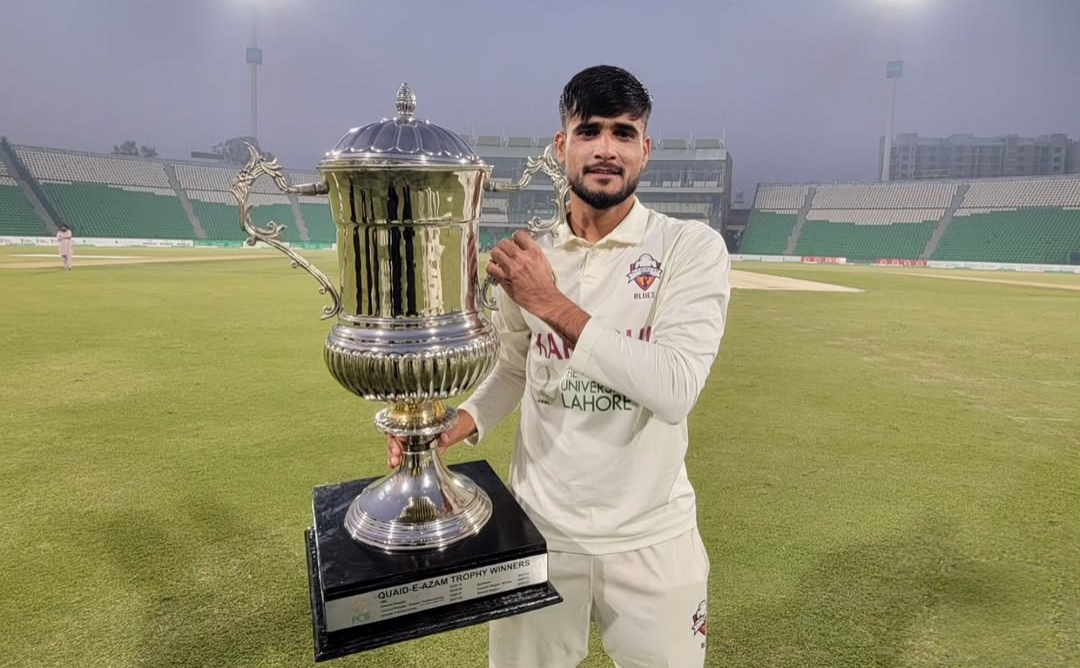
In a Quaid-e-Azam Trophy season dominated by Karachi’s new generation, no player embodied the team’s fire and revival more than Saqib Khan, the wiry, relentless pacer who finished as the tournament’s second-highest wicket-taker and the heartbeat of Karachi’s title-winning attack.
Across nine matches, Saqib collected 47 wickets at 20.59, a haul bettered only by Multan’s Ali Usman. His best figures, a destructive 7 for 34, came in the middle of Karachi’s campaign when they were scrambling to stay alive in the tournament, a spell that not only turned a match but arguably altered Karachi’s entire season trajectory.
Karachi entered the latter half of the season with no margin for error. To even dream of a place in the final, they needed to win-out five straight matches. Saqib delivered every time the pressure peaked.
New ball, old ball, morning spells or twilight grit, he became Saud Shakeel’s most trusted weapon. His ability to hit awkward lengths at pace, extract subtle movement, and stay miserly in long spells allowed Karachi to dominate sessions, the bedrock of their championship run.
If Karachi’s road to the final was built on Saqib’s consistency, the trophy was sealed by his ruthlessness.
In the title clash against Sialkot, Saqib produced a match-winning performance with 9 wickets for 165, including a pivotal five-for on the final day that shattered Sialkot’s resistance just when the game threatened to stretch deep.
His dismissal of Mohammad Hurraira early on day five cracked open the contest, and from there Karachi never loosened their grip. With every strike, the fielders surged, Karachi’s bench roared, and Sialkot’s chase crumbled.
Karachi cricket has long been associated with batting — from Hanif Mohammad to Younis Khan to Asad Shafiq. Saqib’s rise adds a fresh dimension to the narrative. His 47 wickets are the most by a Karachi pacer in a season in over a decade.
In a tournament where Karachi produced the best batter (Saad Baig), the Player of the Final (Abdullah Fazal), and the championship-winning team, Saqib’s emergence as their pace spearhead is perhaps the most encouraging sign for Pakistan’s red-ball future.